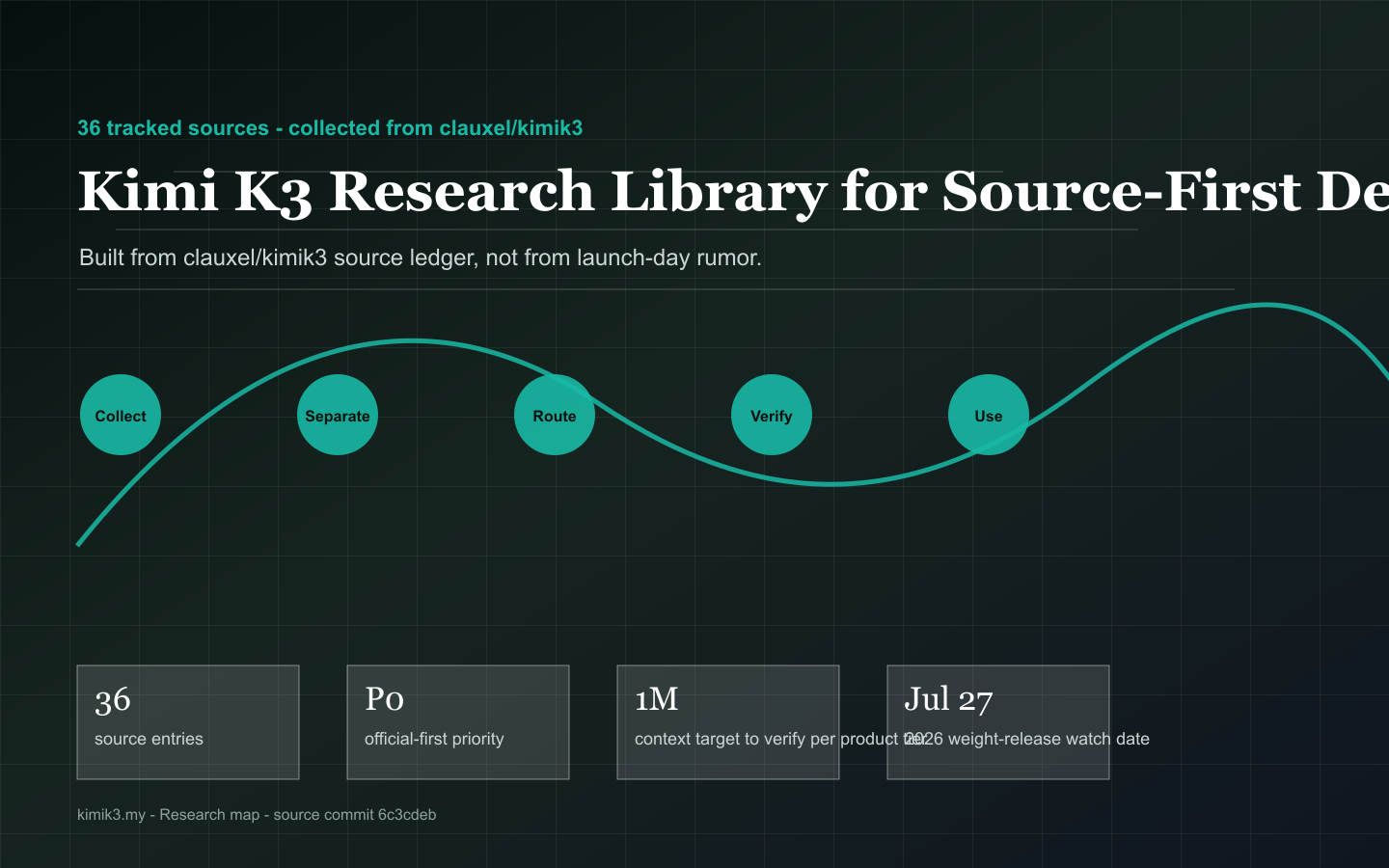
36 tracked sources - collected from clauxel/kimik3
Kimi K3 Research Library for Source-First Decisions
Turn the Kimi K3 launch into a usable research map: verify official facts, estimate API cost, size long-context work, plan local deployment, and track weights without confusing announcements with released artifacts.
The video is paired with page-specific captions so the moving layer explains the same source-backed path as the text.
Kimi K3 Research Library for Source-First Decisions
Turn the Kimi K3 launch into a usable research map: verify official facts, estimate API cost, size long-context work, plan local deployment, and track weights without confusing announcements with released artifacts.
Collect
Separate
Route
Verify
Use
Practical entry
Use the source map without opening every document
Choose the decision you need, then jump to the page that contains the right calculator, checklist or caveat.
Every text section is paired with a visual model so the page can be scanned as a decision guide, not just read as an essay.
Start with the difference between a fact and a release
The repository separates Kimi K3's launch claims from artifacts that still need verification. Use the official launch blog for the model identity, use API docs for callable behavior, and use the watchlist before treating weights or a technical report as released.
A page-specific visual aid derived from the source map.
Use the library as a decision path
If you are budgeting, open the API cost page. If you are preparing prompts, use the context planner. If you are thinking about self-hosting, start with deployment caveats. If you need citations, open the source cards at the end of each page.
A page-specific visual aid derived from the source map.
What the current source ledger says
As captured in the repository on July 23, 2026, Kimi K3 was announced on July 16, 2026; the technical report and full weights were still pending in that scan; no official MoonshotAI GitHub or Hugging Face Kimi-K3 weight repository was found.
A page-specific visual aid derived from the source map.
Research method
How to read the map before making a plan
These notes explain how the source ledger becomes practical guidance while keeping dates, uncertainty and source identity intact.
Start from provenance
A model launch creates many copies, summaries and placeholder pages. This map keeps the collection date, source type, publisher, priority and status near the claim so a reader can tell whether a statement comes from an official page, API documentation, a research paper, a review, or a community discussion. When the same claim appears in several places, the earliest official source should carry more weight than a rewritten summary.
Turn notes into decisions
The useful question is usually operational: can a team call the model today, estimate a workload, reserve enough context, prepare a gateway, compare task quality, or wait for a verified artifact? Each route turns the ledger into one of those decisions instead of leaving the reader with a flat bibliography. That keeps the page useful for engineers, founders, writers and analysts who arrive with different next steps.
Keep pending items visible
Open-weight status, technical reports, model cards, licenses, checksums and runtime recipes can change after a scan. The site keeps those moving parts visible and dates them, so teams can revisit the same checks before deployment, redistribution, benchmark publication, or hardware planning. A dated unknown is better than a confident but unsupported instruction.
Prefer repeatable checks
A single article or social post is a clue, not an operating plan. Before a team changes a roadmap, it should repeat the small checks that matter: confirm the publisher, compare the current docs with earlier notes, record the exact page date, and keep a tiny acceptance prompt or workload estimate beside the decision. That paper trail makes later updates easier to audit, safer to share, and clearer for teammates who revisit the plan. It also prevents stale launch-week notes from becoming permanent architecture.
Source notes
Evidence this page is built on
External references are kept here as source notes. They support the page but do not replace the on-page decision tools.
Official Kimi K3 launch blog
Use this for model identity, 2.8T scale, KDA, Attention Residuals, native vision, 1M context, and the pending technical report boundary.