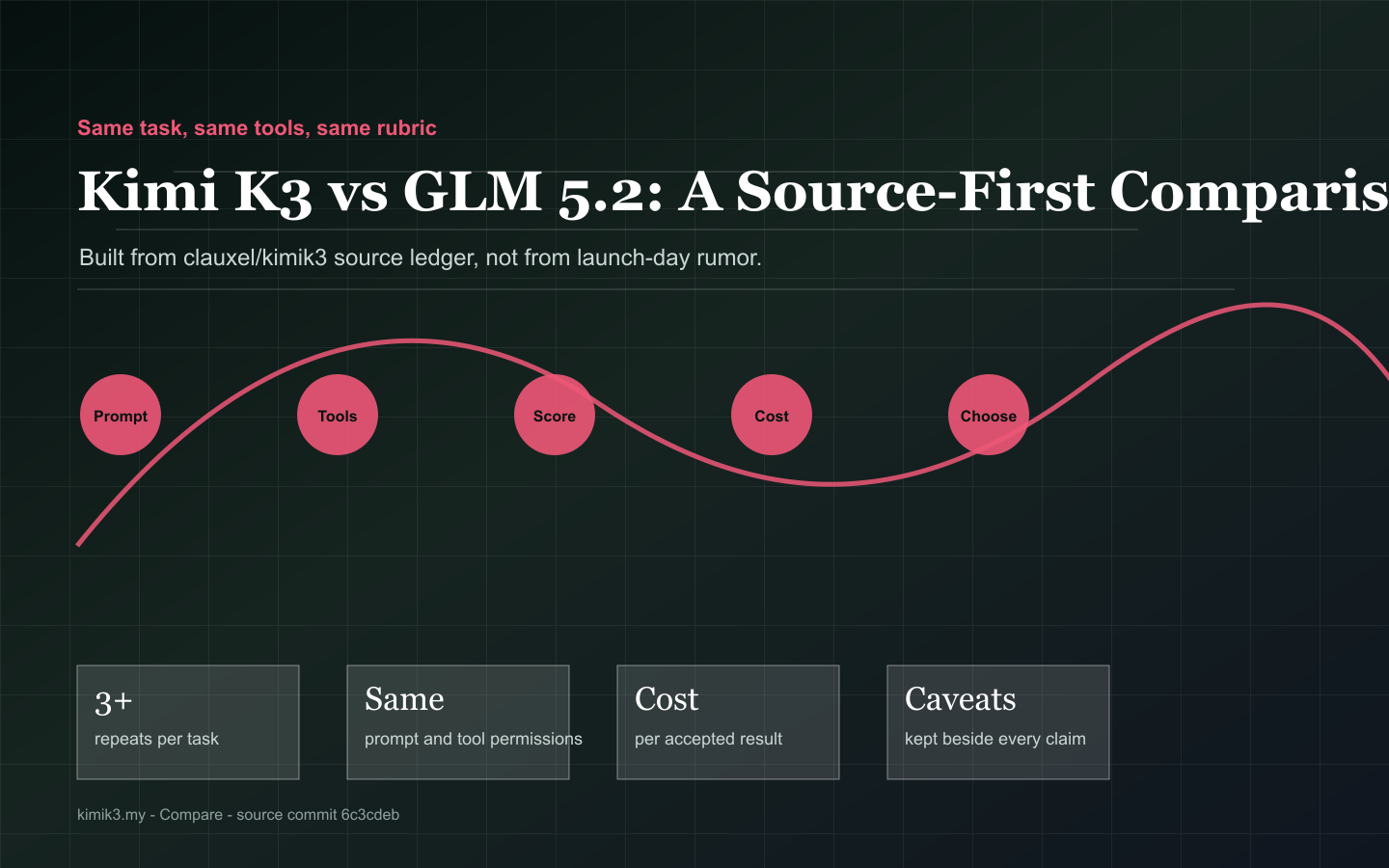
Kimi K3 vs GLM 5.2: A Source-First Comparison Framework
Use the repository's reviews and media map as context, then run your own acceptance set before choosing a model for coding, long context, API cost or deployment.
The video is paired with page-specific captions so the moving layer explains the same source-backed path as the text.
Kimi K3 vs GLM 5.2: A Source-First Comparison Framework
Use the repository's reviews and media map as context, then run your own acceptance set before choosing a model for coding, long context, API cost or deployment.
Prompt
Tools
Score
Cost
Choose
Comparison scorepad
Weight your own workload instead of copying a launch-week verdict
Move the sliders after running your own prompt set. The output is a planning note, not a benchmark claim.
Kimi K3
GLM 5.2
Useful interpretation
What this page helps you decide
Every text section is paired with a visual model so the page can be scanned as a decision guide, not just read as an essay.
Do not let launch-week reviews become universal scores
The source ledger includes news, early reviews, community threads and measurement disclosures. Use them as leads, not final proof. A valid comparison needs the same task set, date, provider mode and scoring rubric.
A page-specific visual aid derived from the source map.
Score what users accept
For coding, record compile success, test pass rate, regression count, diff size and review minutes. For research, record citation accuracy, instruction retention and evidence placement across long prompts.
A page-specific visual aid derived from the source map.
Compare total operating cost
API token rates are only one part of the decision. Add retries, latency, human review and deployment support. A lower list price can lose when it needs more attempts.
A page-specific visual aid derived from the source map.
Source notes
Evidence this page is built on
External references are kept here as source notes. They support the page but do not replace the on-page decision tools.
Nature Kimi K3 science news
Use this as a scientific-community reaction source, not as a replacement for primary benchmarks.