Separate list price from accepted-result cost
The useful unit is not only one million tokens. Track cached input, fresh input, output, retries, failure rate and review minutes for the workload you actually ship.
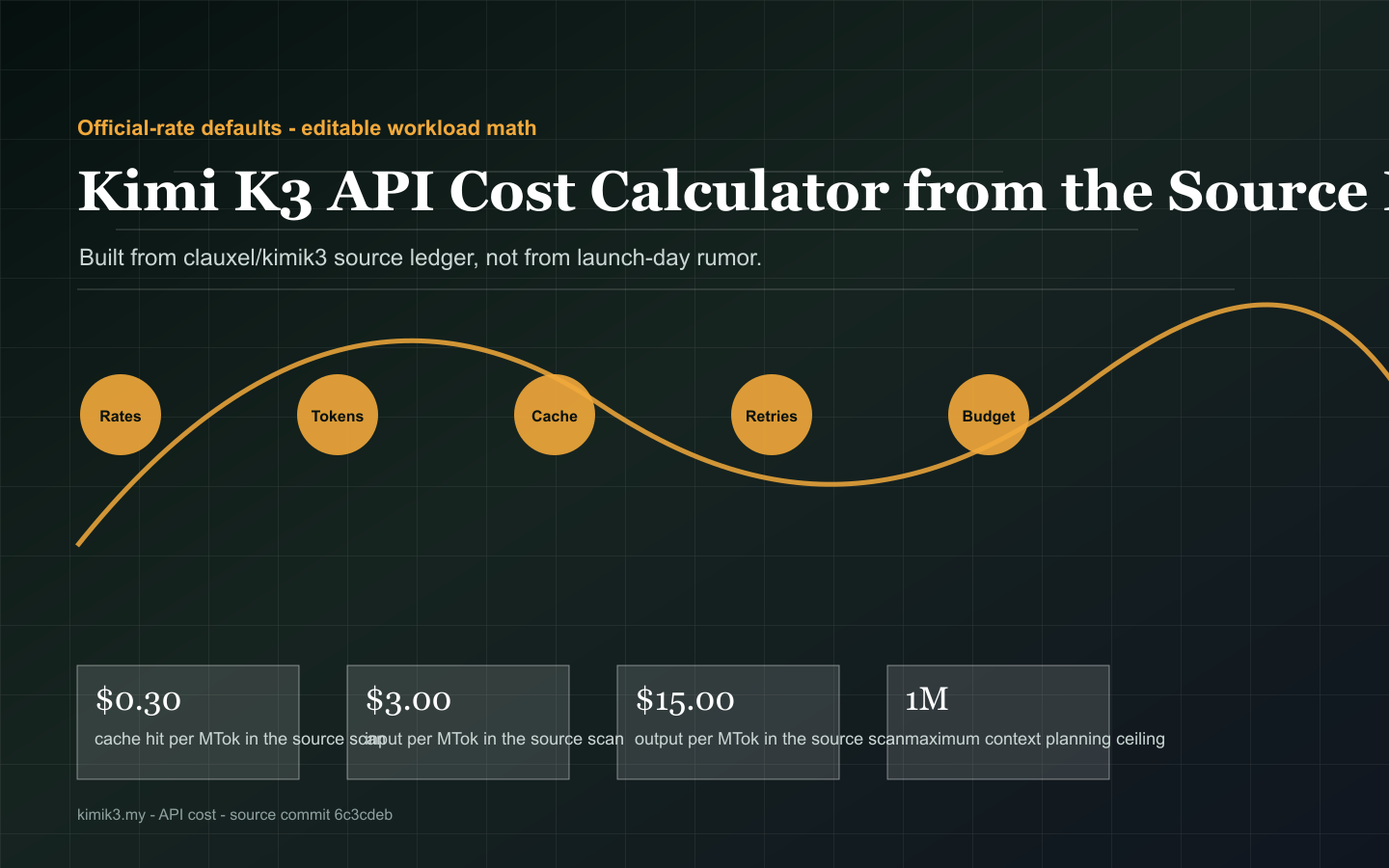
Official-rate defaults - editable workload math
Use the repository's API pricing notes as a starting point, then model your own workload before committing to long-context or agentic usage.
Page video
The video is paired with page-specific captions so the moving layer explains the same source-backed path as the text.
Use the repository's API pricing notes as a starting point, then model your own workload before committing to long-context or agentic usage.
Cost calculator
Defaults come from the July 23, 2026 source ledger. Verify current official pricing before purchase.
Useful interpretation
Every text section is paired with a visual model so the page can be scanned as a decision guide, not just read as an essay.
The useful unit is not only one million tokens. Track cached input, fresh input, output, retries, failure rate and review minutes for the workload you actually ship.
The source ledger points to OpenAI-compatible quickstart material, Kimi K3 API guide details, reasoning effort controls, streaming, structured output and vision-input limitations.
API prices can change. This page keeps the defaults editable and shows the collection date so estimates do not become unsupported invoice promises.
Source notes
External references are kept here as source notes. They support the page but do not replace the on-page decision tools.
Use this for default API cost assumptions: cache hit, input, output, and flagship K3 positioning.
Use this for pay-as-you-go framing and the separation of input, output, and cached token cost.
Use this for OpenAI-compatible base URL, example model name, and language examples.
Use this for reasoning effort, max completion tokens, streaming, vision input, structured output, tools, and limitations.
Use this for Kimi Code model ID, 1M context configuration, and OpenAI/Anthropic compatible coding endpoints.
FAQ
Short answers keep limits, dates and source boundaries explicit.
The defaults follow the July 23, 2026 source ledger: cache hit, input, and output prices from the Kimi API platform notes.
No. It is a transparent workload estimator. Verify current provider prices and taxes before purchasing.
Long-context and tool workflows often need retry or review overhead; accepted-result cost is more useful than token list price alone.
Next decisions
Move to the neighboring decision instead of restarting from a search result.