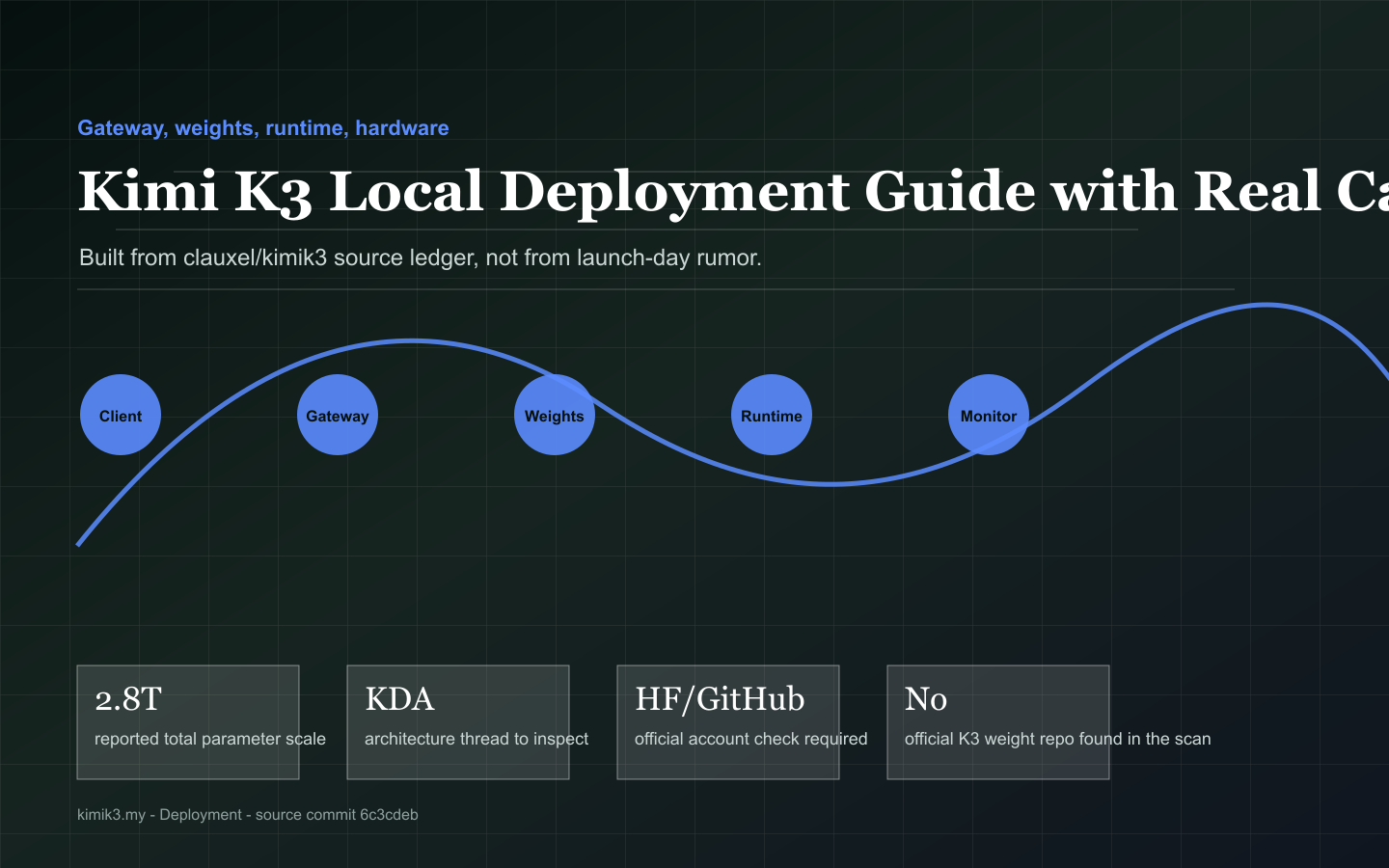
Do not buy hardware from a headline number. Start with the source ledger, separate client, gateway and inference layers, and wait for official weights before sizing a full local runtime.
The video is paired with page-specific captions so the moving layer explains the same source-backed path as the text.
Kimi K3 Local Deployment Guide with Real Caveats
Do not buy hardware from a headline number. Start with the source ledger, separate client, gateway and inference layers, and wait for official weights before sizing a full local runtime.
Client
Gateway
Weights
Runtime
Monitor
Practical entry
Use the source map without opening every document
Choose the decision you need, then jump to the page that contains the right calculator, checklist or caveat.
Every text section is paired with a visual model so the page can be scanned as a decision guide, not just read as an essay.
Local does not always mean local inference
A local web client, private API gateway, quantized lab runtime and full multi-accelerator inference cluster are different deployment shapes. Decide which data and artifact layers must stay inside your network.
A page-specific visual aid derived from the source map.
Use architecture papers as planning context, not hardware quotes
Kimi Linear, Attention Residuals and FlashKDA explain why long-context inference may become practical, but they do not replace the final K3 model card, tokenizer, chat template, license and inference recipe.
A page-specific visual aid derived from the source map.
Create a release-day verification ritual
When weights appear, check publisher identity, repository path, license, checksums, file list, tokenizer, runtime instructions and reproducible smoke prompts before changing production plans.
A page-specific visual aid derived from the source map.
Source notes
Evidence this page is built on
External references are kept here as source notes. They support the page but do not replace the on-page decision tools.
Official Kimi K3 launch blog
Use this for model identity, 2.8T scale, KDA, Attention Residuals, native vision, 1M context, and the pending technical report boundary.
Short answers keep limits, dates and source boundaries explicit.
Can I run Kimi K3 locally today?
The source ledger did not find an official Kimi-K3 weight repository in its July 23, 2026 scan, so full local inference should wait for verified artifacts.
What can I build before weights land?
A local UI or private gateway can be built first, keeping the backend swappable once official runtime artifacts are verified.
Is FlashKDA enough for self-hosting?
No. It is an architecture implementation trail; the final K3 release still needs model artifacts, license, tokenizer, runtime guidance and sizing evidence.
Next decisions
Continue through the research map
Move to the neighboring decision instead of restarting from a search result.